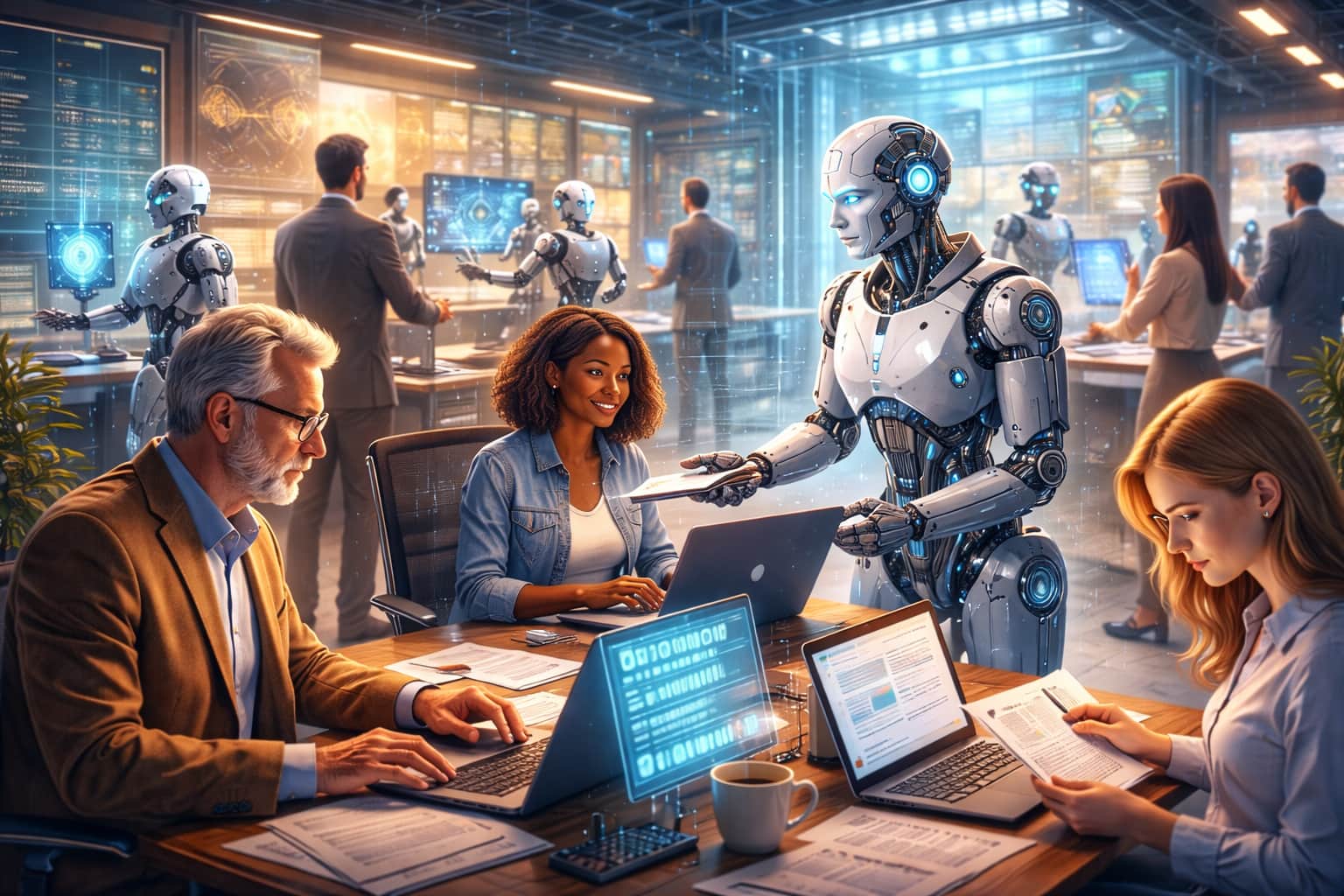
Did you know that nearly half of today’s job tasks can already be partially automated using artificial intelligence?
As AI tools grow more advanced, a common question keeps resurfacing across industries, boardrooms, and online discussions: can AI completely replace human workers? From automated customer support and content creation to data analysis and manufacturing, AI is already reshaping how work gets done. These rapid changes spark both excitement and fear.
Some believe AI will eliminate millions of jobs, making human labor obsolete. Others argue that AI will create new opportunities while enhancing human productivity. The truth lies somewhere in between.
This article explores whether AI can fully replace human workers, where automation truly excels, where humans remain irreplaceable, and how the future of work is likely to evolve in an AI-driven world.
Understanding What AI Can and Cannot Do
Artificial intelligence excels at pattern recognition, data processing, and repetitive task execution. It works best in environments with clear rules, large datasets, and predictable outcomes.
AI can:
Analyze massive amounts of data quickly
Perform repetitive tasks without fatigue
Identify trends and anomalies
Follow predefined instructions consistently
However, AI lacks consciousness, emotional understanding, and genuine creativity. It does not understand context the way humans do, nor can it apply moral judgment or intuition beyond its training.
This fundamental limitation shapes how far AI replacement can realistically go.
Jobs Most Vulnerable to AI Automation
Some roles are more susceptible to automation than others.
Repetitive and Rule-Based Jobs
Tasks that follow clear patterns are easiest to automate. These include:
Data entry
Basic bookkeeping
Assembly line work
Simple customer queries
AI-powered systems can perform these tasks faster and with fewer errors than humans.
Data-Heavy Roles
AI thrives on large datasets. Roles involving data processing or analysis often benefit from automation, such as:
Financial forecasting
Market analysis
Fraud detection
Inventory management
In these areas, AI often replaces tasks rather than entire jobs.
Jobs AI Cannot Fully Replace
Despite its capabilities, AI struggles with work that requires human depth.
Creativity and Original Thought
While AI can generate text, images, or music, it relies on existing patterns. It cannot truly innovate, imagine, or create meaning from lived experience.
Creative roles that depend on originality, storytelling, and emotional resonance remain human-driven.
Emotional Intelligence and Empathy
Jobs involving emotional connection rely heavily on human understanding. These include:
Therapists and counselors
Teachers
Social workers
Healthcare professionals
AI can assist, but it cannot replace genuine human empathy.
Complex Decision-Making and Ethics
Many roles require judgment in uncertain situations. Leaders, strategists, and professionals often make decisions based on incomplete information, ethics, and values.
AI lacks moral responsibility and cannot be held accountable for outcomes. Humans must remain in control.
AI as a Job Transformer, Not Just a Job Killer
The most realistic impact of AI is not total replacement but transformation.
Task Automation Within Jobs
Most jobs consist of multiple tasks. AI tends to automate specific tasks rather than entire roles. This allows workers to focus on higher-value activities.
For example:
Doctors use AI for diagnosis support but make final decisions
Writers use AI for drafting but add insight and voice
Marketers use AI for analytics but shape strategy
This collaboration increases productivity rather than eliminating jobs.
Creation of New Roles
As AI adoption grows, new roles emerge:
AI trainers
Prompt engineers
Ethics and compliance specialists
AI system auditors
History shows that technological shifts often create more jobs than they destroy, although the transition can be challenging.
The Human Skills AI Cannot Replicate
To understand why AI cannot fully replace humans, it helps to look at uniquely human skills.
Critical Thinking
Humans evaluate information, challenge assumptions, and adapt to unexpected situations. AI operates within predefined boundaries.
Cultural and Social Understanding
Human communication is shaped by culture, tone, humor, and context. AI often struggles with nuance and sensitivity.
Accountability and Responsibility
When decisions impact lives, someone must be responsible. AI cannot take responsibility or be ethically accountable.
These qualities ensure humans remain essential in the workforce.
The Role of Education and Reskilling
As AI transforms work, adaptation becomes crucial.
Lifelong Learning
Workers who continuously learn new skills are less vulnerable to automation. Skills such as problem-solving, communication, and digital literacy grow in importance.
Human-AI Collaboration Skills
Knowing how to work with AI tools is becoming as important as technical expertise. Workers who can guide, evaluate, and improve AI outputs gain an advantage.
Reskilling is not optional in the AI era. It is necessary for long-term career resilience.
Ethical and Social Considerations
The question of AI replacing workers is not purely technical. It is deeply social.
Economic Inequality
Unchecked automation could widen income gaps if benefits are concentrated among a few. Responsible AI adoption requires policies that support workers during transitions.
Fair Use of Automation
Businesses must balance efficiency with social responsibility. Replacing humans simply because AI is cheaper can lead to long-term societal costs.
Regulation and Governance
Governments play a role in setting boundaries for AI use, protecting workers, and ensuring ethical deployment.
The Future of Work in an AI-Driven World
The future will likely be hybrid rather than automated.
Humans and AI Working Together
AI will handle speed, scale, and repetition. Humans will handle creativity, judgment, and leadership.
This partnership leads to:
Higher productivity
Better decision-making
Improved work quality
Shifting Job Definitions
Job titles may change, but human contribution will remain central. Work will focus more on value creation rather than routine execution.
Can AI Completely Replace Human Workers?
The simple answer is no.
AI can replace certain tasks and transform many jobs, but it cannot fully replace human workers. Work is not just about efficiency. It involves meaning, ethics, creativity, and connection.
The real challenge is not whether AI will replace humans, but how humans will adapt, learn, and shape AI to serve society responsibly.
Those who embrace AI as a tool rather than fear it as a threat will thrive in the future of work.
Conclusion
AI is undeniably changing how work is done. It automates tasks, improves efficiency, and opens new possibilities across industries. However, it does not eliminate the need for human workers.
Human skills such as creativity, empathy, judgment, and accountability remain irreplaceable. The future of work is not about humans versus AI. It is about humans working with AI.
By investing in education, ethical frameworks, and human-centered innovation, society can ensure AI enhances work rather than replaces it.
The workforce of tomorrow will not be automated. It will be augmented.
FAQs
Q1. Will AI take all jobs in the future?
No. AI will automate tasks, not eliminate all jobs. Human skills remain essential.
Q2. Which jobs are safest from AI?
Roles requiring creativity, empathy, leadership, and complex decision-making are least likely to be replaced.
Q3. Should workers fear AI?
Fear is understandable, but adaptation is more productive. Learning to work with AI offers new opportunities.
Q4. Can AI replace managers or leaders?
AI can assist with data and insights, but leadership requires human judgment and responsibility.
Q5. How can people prepare for an AI-driven future?
By developing adaptable skills, embracing lifelong learning, and understanding how to collaborate with AI tools.