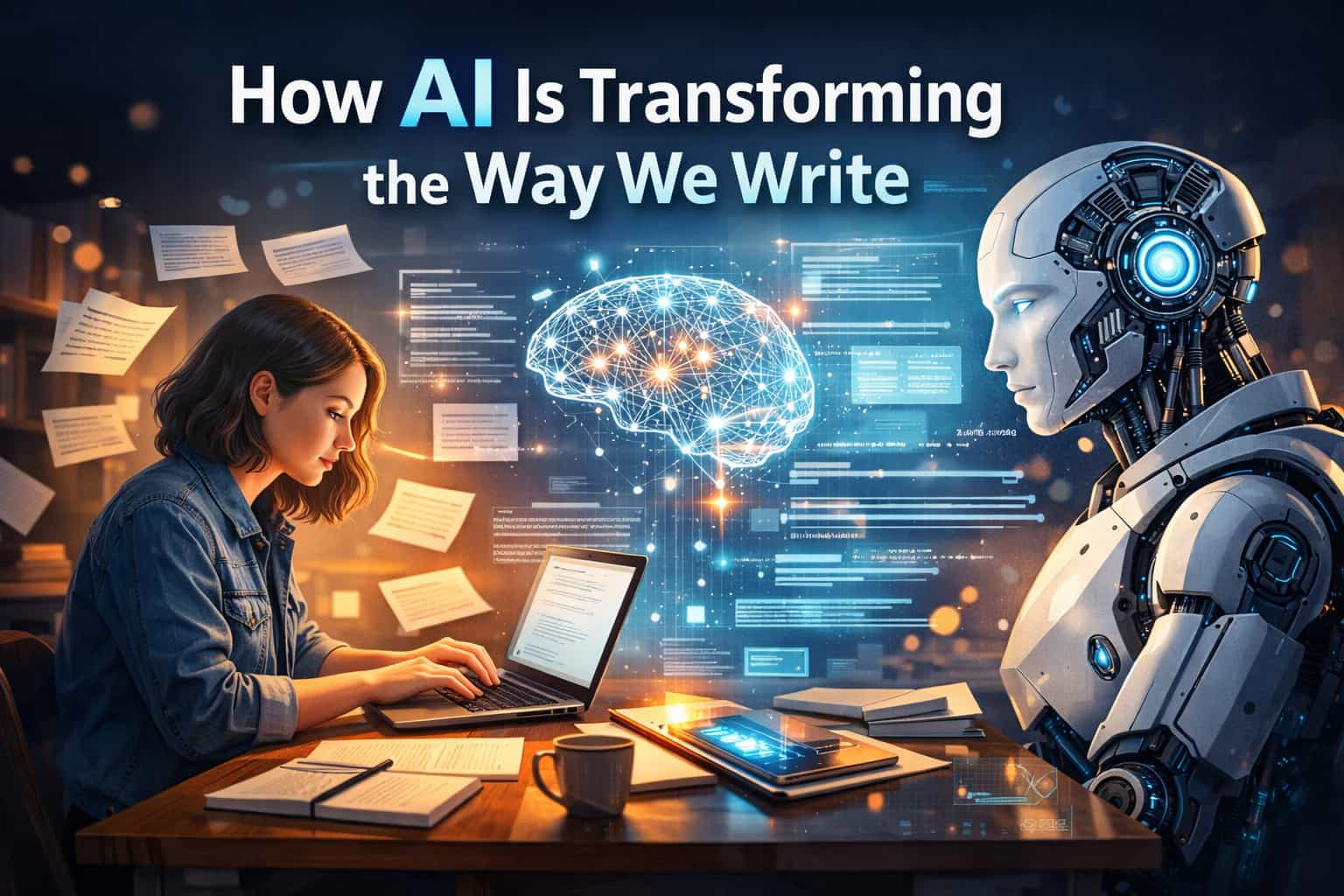
Did you know that writers today can produce in minutes what once took days—without sacrificing quality?
The act of writing has always evolved with technology. From quills to typewriters, and from word processors to cloud-based editors, every shift has changed how ideas move from the mind to the page. Today, artificial intelligence represents the biggest transformation yet. AI-powered writing tools are not just speeding up the process—they are reshaping creativity, productivity, and the very definition of authorship.
AI can now brainstorm ideas, generate outlines, rewrite paragraphs, improve clarity, adjust tone, and even help writers overcome creative blocks. Whether you’re a blogger, copywriter, novelist, student, or business professional, AI is becoming a powerful writing partner rather than a replacement.
This guide explores how AI is transforming the way we write—from idea generation to final edits—while showing practical examples, benefits, limitations, and best practices. By the end, you’ll understand how to use AI effectively while keeping your voice, originality, and intent intact.
Let’s explore how writing is changing—and how you can adapt without losing your creative edge.
The Evolution of Writing Tools
Writing has never been a static craft. Each technological leap has reduced friction between thought and expression.
Handwritten manuscripts required extreme effort and time
Typewriters improved speed but limited editing
Word processors introduced easy revisions
The internet enabled instant publishing
AI now assists with thinking, structuring, and refining ideas
AI doesn’t just help writers type faster—it helps them think differently. It acts as a collaborator that can suggest possibilities, identify weaknesses, and offer alternatives at scale.
Unlike traditional tools, AI interacts with language itself. That’s what makes it revolutionary.
How AI Helps Writers Generate Ideas
One of the hardest parts of writing is starting. AI excels at breaking that barrier.
Brainstorming Topics and Angles
AI tools can generate dozens of topic ideas in seconds based on a single prompt. For example:
“Give me blog ideas about sustainable fashion”
“Suggest unique angles for an article on remote work”
“What are trending subtopics in digital marketing?”
Instead of staring at a blank page, writers can instantly explore multiple directions.
Expanding a Simple Idea
AI is especially useful for idea expansion. A basic concept like “AI in education” can quickly become:
Personalized learning with AI tutors
Ethical concerns in AI-assisted classrooms
How teachers can work alongside AI tools
This allows writers to choose stronger, more focused concepts early in the process.
Turning Ideas Into Clear Structure
Great writing isn’t just about ideas—it’s about organization.
Creating Outlines and Frameworks
AI can generate structured outlines for:
Blog posts
Essays
Scripts
Emails
Whitepapers
For example, a prompt like “Create an outline for an article on AI in writing” can return a logical, reader-friendly structure in seconds.
Writers remain in control—they choose what to keep, cut, or rearrange.
Improving Logical Flow
AI can analyze drafts and suggest:
Better section ordering
Missing transitions
Redundant points
This makes long-form writing clearer and more cohesive, especially for beginners.
Writing Faster Without Losing Quality
Speed is one of AI’s most noticeable benefits—but quality still depends on the writer.
Drafting Assistance
AI can generate first drafts based on outlines or prompts. These drafts are not meant to be final versions but starting points.
Writers can then:
Rewrite sections in their own voice
Add personal insight or expertise
Remove generic phrasing
This dramatically reduces drafting time while preserving originality.
Overcoming Writer’s Block
When writers feel stuck, AI can help by:
Suggesting next paragraphs
Rewriting sentences in different tones
Offering alternative phrasings
Instead of stopping completely, writers stay in momentum.
Enhancing Tone, Style, and Clarity
Good writing is not just correct—it’s engaging.
Adjusting Tone for Different Audiences
AI can adapt content for:
Formal or conversational tone
Technical or beginner-friendly language
Professional, persuasive, or storytelling styles
For example:
“Make this paragraph more conversational”
“Rewrite this for a non-technical audience”
This is especially useful for marketers and content creators who write for multiple platforms.
Improving Readability
AI tools help:
Shorten long sentences
Replace vague wording
Remove repetition
Improve flow
They act like a tireless editor that works instantly.
Editing and Revising With AI
Revision is where strong writing is made—and AI excels here.
Grammar and Style Corrections
AI can detect:
Grammar errors
Awkward phrasing
Inconsistent tense
Passive voice overuse
Unlike basic spell-checkers, AI explains why changes are suggested, helping writers improve over time.
Content Refinement
Writers can ask AI to:
“Tighten this paragraph”
“Make this more persuasive”
“Cut unnecessary words”
This speeds up editing while maintaining intent.
AI as a Creative Partner, Not a Replacement
One of the biggest misconceptions is that AI replaces writers. In reality, it replaces friction, not creativity.
What AI Can Do Well
Generate drafts and variations
Analyze patterns in language
Optimize clarity and structure
Save time on repetitive tasks
What AI Cannot Replace
Lived experience
Emotional authenticity
Original opinions
Cultural nuance
Ethical judgment
The best writing still comes from human insight. AI simply amplifies it.
Real-World Examples of AI in Writing
Blogging and Content Creation
Bloggers use AI to:
Generate outlines
Optimize SEO
Rewrite sections for clarity
Marketing and Copywriting
Marketers rely on AI for:
Ad copy variations
Email campaigns
Landing page optimization
Academic and Educational Writing
Students and educators use AI to:
Summarize research
Improve structure
Clarify complex explanations
Fiction and Storytelling
Writers use AI to:
Explore plot ideas
Develop character backstories
Test alternative endings
In every case, the writer remains the decision-maker.
Ethical Considerations and Responsible Use
With power comes responsibility.
Avoiding Over-Reliance
AI should assist, not dominate. Overuse can lead to:
Generic content
Loss of personal voice
Reduced critical thinking
Ensuring Originality
Writers must:
Edit AI-generated content
Add personal insight
Avoid copying outputs blindly
AI should be a tool—not a shortcut to plagiarism.
Best Practices for Writing With AI
To use AI effectively:
Start with clear prompts
Treat AI drafts as rough versions
Always revise manually
Keep your unique voice
Use AI for efficiency, not identity
The strongest results come from human direction + AI assistance.
The Future of Writing in an AI World
AI will continue to evolve—but writing will remain human at its core.
Future writers will need:
Strong critical thinking
Clear creative intent
Ethical awareness
Editorial judgment
AI will not replace writers—it will raise the standard.
Those who learn to work with AI will write faster, clearer, and more strategically than ever before.
Conclusion
AI is transforming the way we write—but it isn’t taking creativity away. It’s removing obstacles.
From idea generation and outlining to drafting and editing, AI empowers writers to focus on what truly matters: meaning, message, and impact. When used responsibly, it becomes a creative partner that enhances—not replaces—human expression.
Writing has always adapted to new tools. AI is simply the next chapter.
The page is still blank.
The ideas are still yours.
AI just helps you bring them to life—one sentence at a time.
FAQs
Q1. Can AI replace human writers?
No. AI assists with structure, clarity, and speed, but it cannot replace human creativity, emotion, or original thinking.
Q2. Is it ethical to use AI for writing?
Yes, when used responsibly. Writers should edit outputs, ensure originality, and avoid plagiarism.
Q3. Does AI make writing less creative?
No. It removes friction and frees writers to focus more on ideas, storytelling, and insight.
Q4. What types of writing benefit most from AI?
Blogging, marketing, technical writing, and educational content benefit greatly—especially during drafting and editing.
Q5. How can I keep my voice when using AI?
Always revise manually, add personal perspective, and use AI as a starting point—not the final author.