Online education has grown rapidly over the past decade, but artificial intelligence has accelerated this transformation like never before. In the modern era, learning is no longer limited to static video lectures or one-size-fits-all courses. AI-driven systems are reshaping how students learn, how educators teach, and how educational platforms operate.
From personalized learning paths to automated grading and intelligent tutoring systems, AI is redefining education at every level. While online education once struggled with engagement and effectiveness, AI is helping close the gap between digital and traditional classrooms.
This article explores how artificial intelligence is changing online education, the benefits it offers, the challenges it introduces, and what the future of learning may look like in an AI-powered world.
The Rise of AI in Online Learning Platforms
Online education platforms now serve millions of learners worldwide. To manage this scale effectively, many platforms rely on artificial intelligence.
AI helps analyze student behavior, learning speed, strengths, and weaknesses. Based on this data, platforms can adapt content and recommendations automatically. This creates a more efficient and responsive learning environment.
Rather than treating all students the same, AI enables education to become more individualized and outcome-focused.
Personalized Learning Experiences
One of the most significant changes AI brings to online education is personalization.
Adaptive Learning Paths
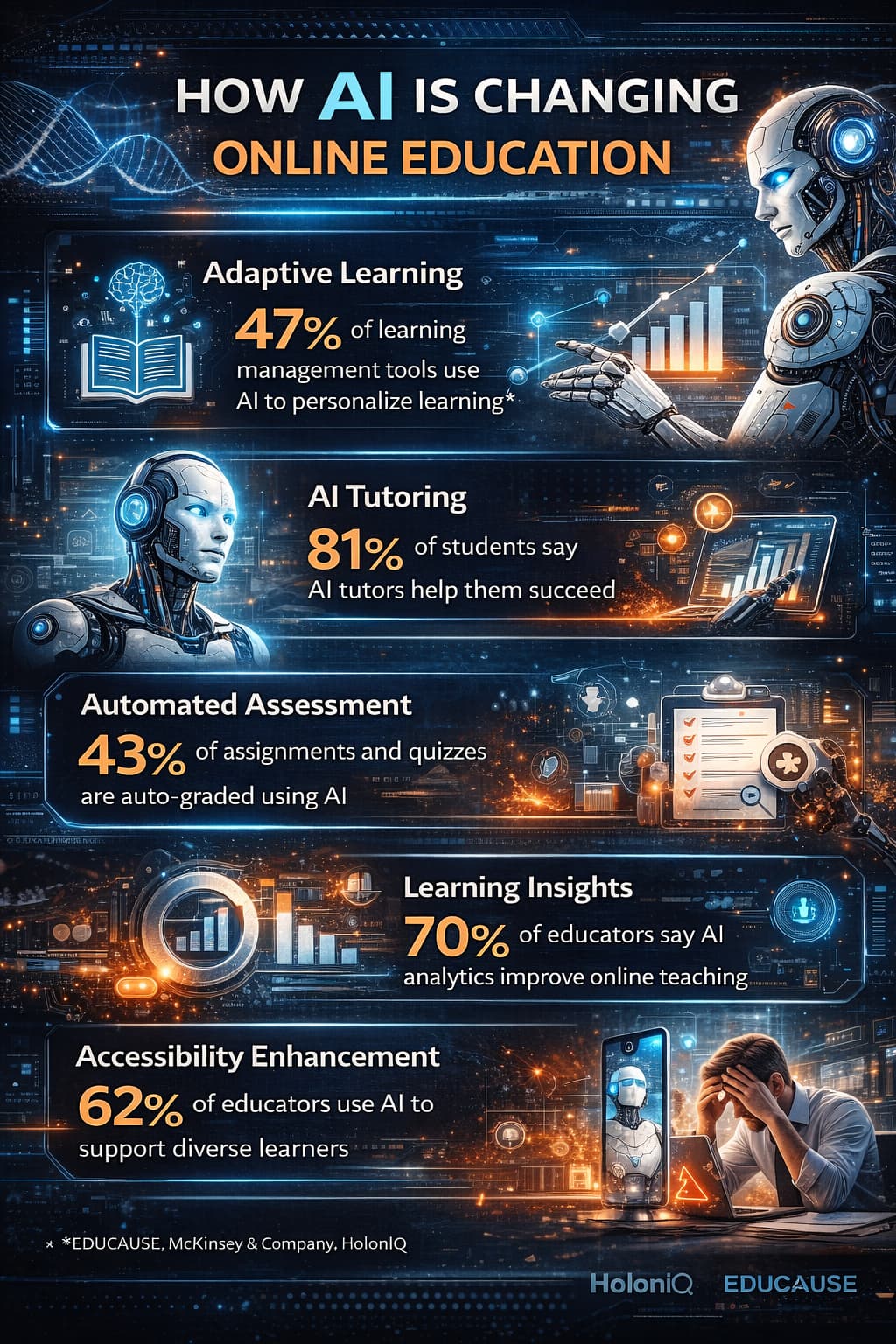
AI systems track how learners interact with content. If a student struggles with a concept, the system can offer additional explanations, exercises, or alternative formats.
If a learner progresses quickly, AI can skip repetitive material and introduce more advanced topics. This keeps students engaged and reduces frustration.
Learning at an Individual Pace
Traditional classrooms often move at a fixed pace. Online education powered by AI allows learners to study when and how they prefer. This flexibility is especially valuable for working professionals and remote learners.
Personalized pacing improves comprehension and long-term retention.
Intelligent Tutoring and Virtual Assistants
AI-powered tutors are becoming increasingly common in online education.
24/7 Learning Support
Virtual tutors can answer questions, explain concepts, and guide learners at any time. Unlike human instructors, AI tutors are always available.
This constant support reduces learning gaps and helps students stay motivated.
Scalable Teaching Assistance
In large online courses, instructors cannot respond to every student individually. AI tutors help fill this gap by handling common questions and providing instant feedback.
This allows educators to focus on higher-level teaching tasks.
Automated Assessment and Feedback
Grading and feedback are time-consuming processes. AI is transforming how assessments are conducted in online education.
Faster and Consistent Grading
AI systems can evaluate quizzes, assignments, and even essays with remarkable speed. This ensures consistency and reduces human error.
Students receive feedback quickly, which improves learning outcomes.
Actionable Insights for Learners
Beyond scores, AI can analyze performance trends and highlight areas for improvement. This helps students understand not just what they got wrong, but why.
Meaningful feedback encourages continuous improvement.
Improved Accessibility and Inclusivity
AI plays a critical role in making online education more accessible.
Support for Diverse Learners
AI-powered tools offer features such as:
Speech-to-text and text-to-speech
Language translation
Visual and audio learning aids
These features support learners with disabilities and those from different linguistic backgrounds.
Breaking Geographic Barriers
Students from remote or underserved regions can access high-quality education through AI-driven platforms. This helps reduce educational inequality on a global scale.
Data-Driven Insights for Educators
AI does not only benefit students. Educators also gain valuable insights.
Monitoring Student Engagement
AI systems track participation, progress, and engagement levels. Educators can identify struggling students early and intervene before problems escalate.
Course Optimization
By analyzing aggregate data, AI helps educators understand which materials work best and which need improvement. Courses evolve continuously based on real learner behavior.
This leads to higher-quality educational content.
Challenges and Limitations of AI in Online Education
Despite its benefits, AI adoption in education comes with challenges.
Data Privacy Concerns
AI relies on collecting and analyzing student data. Without proper safeguards, this raises privacy and security risks.
Educational institutions must ensure transparent data policies and strong protection measures.
Overdependence on Technology
Excessive reliance on AI may reduce human interaction in learning. Education is not just about information delivery. It also involves mentorship, discussion, and emotional support.
Balancing automation with human involvement remains essential.
Ethical Considerations in AI-Powered Learning
Ethics play a critical role in AI-driven education.
Bias in Algorithms
If AI systems are trained on biased data, they may disadvantage certain groups of learners. This can affect assessments, recommendations, and opportunities.
Regular auditing and diverse datasets are necessary to minimize bias.
Transparency and Accountability
Students should understand how AI systems influence their learning experience. Clear communication builds trust and ensures fairness.
The Role of Teachers in an AI-Enhanced Education System
AI does not replace educators. Instead, it reshapes their role.
From Content Delivery to Mentorship
With AI handling repetitive tasks, teachers can focus on mentoring, critical thinking, and personalized guidance.
Human educators remain essential for motivation, ethical discussions, and emotional connection.
Collaboration Between Humans and AI
The most effective education models combine AI efficiency with human insight. Teachers guide learning goals while AI supports execution.
This partnership leads to better outcomes for learners.
The Future of Online Education With AI
AI will continue to shape online education in the coming years.
Lifelong Learning Models
As job markets evolve, continuous learning becomes necessary. AI-powered platforms support lifelong education by adapting to changing skill requirements.
Global Learning Ecosystems
AI enables collaboration across borders, cultures, and institutions. Education becomes more connected and inclusive.
The future of learning is flexible, personalized, and technology-driven.
Conclusion
Artificial intelligence is transforming online education in the modern era. By personalizing learning experiences, improving accessibility, and supporting educators, AI addresses many challenges that once limited digital learning.
However, responsible implementation is crucial. Privacy protection, ethical design, and human oversight must guide AI adoption in education.
When used thoughtfully, AI enhances learning rather than replacing the human element. The goal is not automated education, but empowered learners and educators working together.
Online education is no longer just digital. It is intelligent.
FAQs
Q1. How is AI used in online education?
AI is used for personalization, tutoring, assessment, accessibility, and learning analytics.
Q2. Can AI replace teachers in online education?
No. AI supports teachers but cannot replace human mentorship, judgment, or emotional intelligence.
Q3. Is AI-based education effective?
When implemented responsibly, AI improves engagement, flexibility, and learning outcomes.
Q4. What are the risks of see AI in education?
Privacy concerns, algorithmic bias, and overdependence on technology are key risks.
Q5. What is the future of AI in education?
The future includes personalized, global, and lifelong learning supported by AI and guided by humans.