If you have ever used an AI detector (or even just heard teachers talk about “AI writing”), you have probably seen two words that sound way more complicated than they should.
Perplexity. Burstiness.
At first they feel like science words that belong in a lab, not in your essay. But honestly, the ideas behind them are super simple once you see what they are actually trying to measure.
So let’s explain them like a student would explain them to another student. No fancy talk. No confusing definitions. Just clear examples, and how this connects to writing, AI detectors, and your assignments.
Why do these words even matter?
Because a lot of AI detectors use these ideas to guess whether something looks human-written or AI-generated.
Not perfectly. Nothing is perfect. But these are two common signals.
Think of it like this:
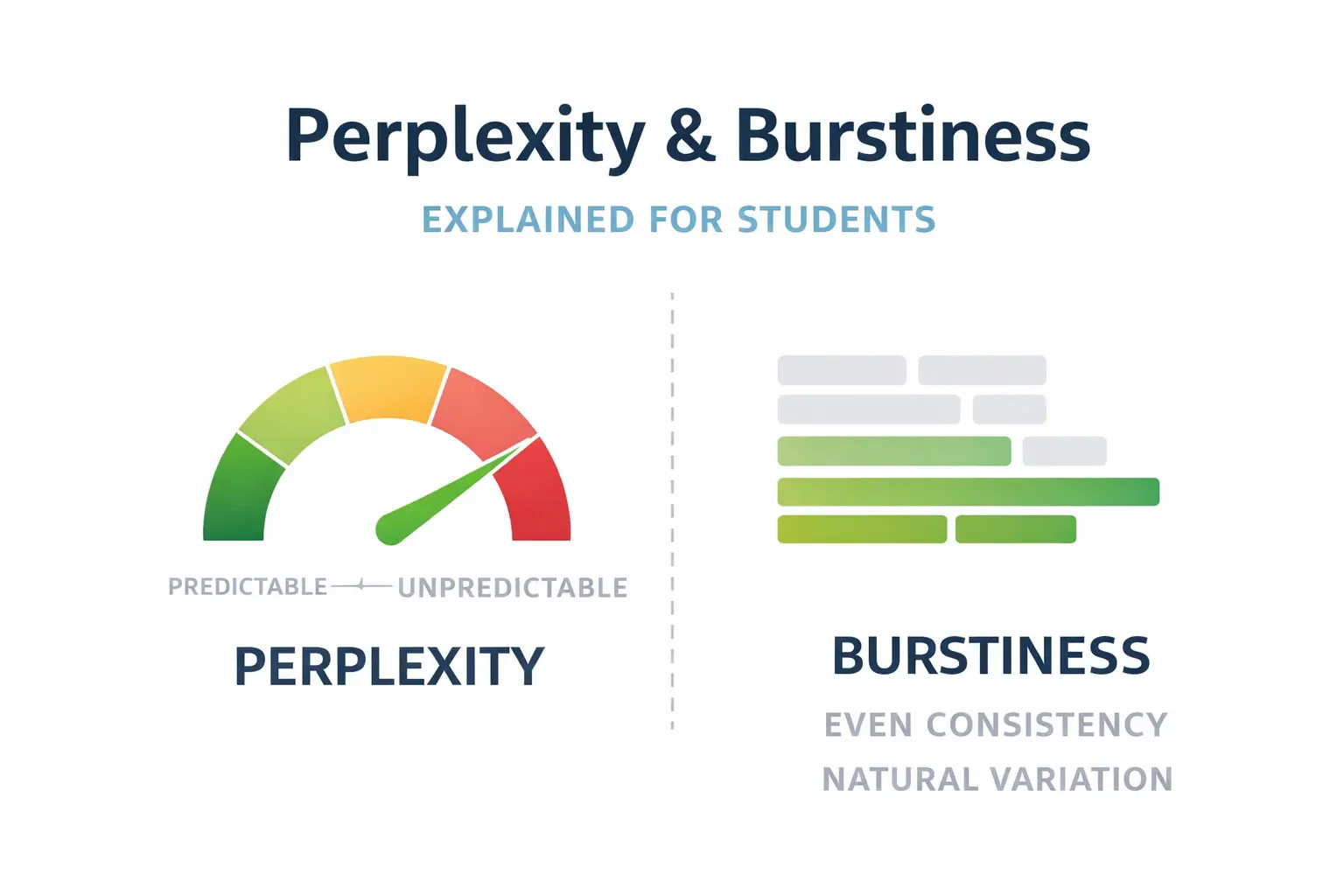
Perplexity is about how “predictable” your writing is.
Burstiness is about how much your writing changes rhythm and style as it goes.
Humans tend to be less predictable and more “messy” in a natural way. AI tends to be more smooth, consistent, and pattern-like.
That is the whole reason these words show up in detection tools.
Perplexity: the “how predictable is this?” score
The simple version
Perplexity is basically a measure of how surprised a language model is by your text.
If the next word is easy to guess, that text is predictable, and perplexity is lower.
If the next word is harder to guess, that text is less predictable, and perplexity is higher.
A normal example
Imagine I start a sentence like this:
“Peanut butter and…”
You already know what is coming. The most common next word is “jelly.”
That phrase is predictable. Low perplexity.
Now imagine I start a sentence like this:
“Peanut butter and…”
I could say “pickles,” “ramen,” “bananas,” “rice,” “regret,” anything. If the sentence goes in an unusual direction, it becomes less predictable.
More surprise. Higher perplexity.
Why humans often have higher perplexity
Because humans write with:
personal examples
random little details
unique phrasing
emotional words
imperfect grammar sometimes
weird but real transitions
Humans are not robots. We do not write with the same “safe” structure every time.
Why AI often has lower perplexity
AI is trained on huge amounts of text. It has learned what words usually come next.
It often chooses the most likely, safest continuation.
That makes AI writing feel smooth, but also kind of generic. It picks common phrases like:
“It is important to note that…”
“In today’s world…”
“This highlights the significance of…”
Those phrases are predictable, so perplexity tends to be lower.
A quick way to feel perplexity in real life
Try this.
Read these two mini paragraphs.
Paragraph A
School is important for students because it helps them learn new skills. It teaches discipline and builds knowledge that can be used in the future. In conclusion, education plays a key role in personal development.
This feels like a safe template. It is not wrong, but it feels like it could be written by anyone.
Paragraph B
School matters, but not just because of grades. It teaches you how to deal with pressure, how to talk to people you do not even like, and how to finish things even when you feel tired. I did not understand that until I messed up a deadline and had to fix it fast.
This one has a more personal flow. It is less predictable. It has a specific detail. It is more human.
That is the vibe detectors look for.
Burstiness: the “does the writing change naturally?” score
Now let’s talk about burstiness.
The simple version
Burstiness is about variation.
Humans usually write with different sentence lengths and different patterns.
Some sentences are short.
Some are long.
Sometimes we explain something. Then we add a quick example. Then we say a short line for emphasis.
AI often writes in a very even rhythm. Like every sentence has the same size and tone.
Burstiness tries to measure that difference.
An easy example
Here is a bursty style:
I studied all night.
Then I realized I was studying the wrong chapter.
Honestly, that moment hurt, but it also taught me to check the syllabus first, because the syllabus is basically the map.
See how it changes pace?
Short. Short. Longer with explanation.
That is natural.
Here is a less bursty style:
Studying is important for academic success. Students should create a plan and follow a consistent routine. This approach helps improve focus and time management. It also reduces stress and increases confidence.
Everything is calm and evenly spaced. It sounds fine, but it is flat.
That evenness is what detectors sometimes notice.
How perplexity and burstiness work together
Think of it like this:
If your writing is too predictable and too smooth, it might look AI-like.
If your writing has natural variation and some unique phrasing, it tends to look more human.
But important note: this does not mean “make your writing messy on purpose.”
It means write like a real person who actually has thoughts.
A small story (because this is exactly how students learn)
Last semester, I had to write a short report. I was tired, so I asked an AI tool to help me rewrite my draft.
It gave me something that looked “better” at first glance.
No grammar issues. Perfect structure. Clean paragraphs.
But when I read it again, I felt like I was reading a brochure.
It did not sound like me. It did not even sound like a student. It sounded like a website trying to sell me education.
That is when I noticed something: the rhythm was too consistent.
Every sentence was medium length. Every paragraph started with a formal topic sentence. Every point had the same “safe” tone.
That is low burstiness. And probably lower perplexity too, because it used common phrases.
So I rewrote it again in my own voice. I kept the good structure, but I added real examples from class and a few lines that sounded like me.
That version felt normal. And my teacher’s feedback was better.
Not because of “AI detection.” Just because the writing sounded real and had real thinking.
How AI detectors use these ideas (in a simple way)
Most detectors do not literally “know” who wrote it.
They look at patterns.
Perplexity and burstiness are two pattern signals.
If the text is extremely predictable and extremely consistent, detectors may label it as likely AI.
If the text has more natural variation and less predictable phrasing, detectors may label it as more human.
Again, it is not perfect. A strong writer can sound smooth. A tired student can sound repetitive. So it is not a magic truth machine.
But it explains why these terms exist.
What students should actually do with this information
You do not need to become a scientist.
You just need to understand one thing:
Good writing is usually human writing.
If your goal is better grades, you should want your writing to be clear, personal, and specific anyway.
Here is how to naturally increase “human signals” without forcing it.
1) Add specific details
Generic writing is predictable.
Specific writing is less predictable.
Instead of saying:
“Students face stress.”
Say:
“Last week, I had two submissions and a quiz in the same day, and I genuinely could not focus until I wrote a quick to do list.”
That one detail changes everything.
2) Mix sentence length
Do not do it like a robot. Just write normally.
If everything sounds the same, add a short sentence sometimes.
Example:
This is where it gets tricky.
That kind of line is normal human writing.
3) Use your own examples and opinions
AI can explain concepts, but your experience is your experience.
Even in a formal essay, you can still use your own reasoning:
I think this matters because…
Teachers love that, as long as you support it with logic.
4) Avoid filler phrases you do not use in real life
If you never say “moreover” in real life, do not force it in writing.
If you never say “it is imperative,” do not pretend you do.
Write like a smart student, not like a corporate email.
5) Read it out loud once
This is the easiest trick.
If it sounds weird out loud, it probably reads weird too.
When it sounds like a real person talking, it usually reads more human.
Common mistakes that make writing look AI-like
Even if you write it yourself, these patterns can make it feel robotic:
repeating the same sentence structure
using too many perfect transitions like “furthermore, additionally, moreover”
writing with zero personal or class-specific details
over-explaining obvious points
ending every paragraph with a “mini conclusion” that sounds copied
The solution is not to panic.
The solution is to write with real details and real reasoning.
Quick mini checklist for a “more human” essay
Before you submit, check:
Do I have at least 2 real examples in the whole essay?
Do my sentences have some variety?
Do I sound like myself, or like a Wikipedia summary?
Did I include any class concepts properly (and cite if needed)?
If I read the intro out loud, does it sound natural?
If you can say yes to most of these, your writing is already in a better place.
Final takeaway
Perplexity and burstiness are not scary.
They are just two ways of describing something you already understand:
AI writing often feels predictable and evenly polished.
Human writing usually has natural variation, specific details, and a real voice.
If you write like a real student who has real thoughts and examples, you will usually score better anyway.
So do not treat this like a “detector hack.”
Treat it like a writing upgrade.